
As I write this, it’s Boxing Day 2024. You’ve probably received a Christmas card this year, or at least seen one on social media. If you work in an organization, you might have received a holiday email and even participated in a gift exchange, especially if you’re part of a Rotary club. You may be wondering where I’m going with this, but I want to share some thoughts and observations specifically for a Ugandan audience when it comes to Christmas cards.
I had planned to write and publish this on Christmas Day, as the message relates to cards made for the occasion. However, after returning from church at 9:30 a.m., I prepared lunch and took a nap around 2 p.m., only to wake up just before 8 p.m. Unfortunately, I didn’t have the time to write and publish the piece. To my son, Awesome, and to the children yet to come, here are my thoughts on Christmas cards for 2025.
What is the current situation with Christmas cards in Uganda, targeting 90% of the Ugandan audience? Most of the cards I’ve seen and received include the following elements: traditional symbols like Christmas trees, ornaments, wreaths, snowflakes, stockings, Santa, reindeer, angels, and elves; winter scenes with snow-covered landscapes, cozy homes, fireplaces, or snowy villages; and religious imagery, such as nativity scenes, stars, or angels. These cards are incomplete without a warm, personalized message, such as “Merry Christmas,” “Happy Holidays,” or “Season’s Greetings,” all wrapped in a color scheme featuring red, green, gold, silver, and white.
My dear son, the question that often occupies my mind as a communication and social media professional in Uganda is: Which of these traditional symbols truly relate to the Ugandan Christmas season? Let’s start with Christmas trees. In my thirties today, I remember the excitement of going out to find a specific tree to decorate during Christmas, and this tradition still happens in some homes and workplaces. Some ornaments, particularly bells, were in use as I grew up. But Uganda is a tropical country, located on the equator, and we don’t receive snow, except at the peak of Mt. Rwenzori. Despite being the Pearl of Africa and home to the big five, Uganda doesn’t have reindeer and elves, not even in our folk tales. Unless you’ve hiked Mt. Rwenzori, you won’t encounter snow-covered landscapes. I could go on, but I think you get the point.
So, what does the Christmas season look like in Uganda? It begins at the start of the year, with people saving money for the upcoming holiday. As December starts, many take leave from work, and traffic becomes a nightmare as roads out of Kampala and other major cities are packed with travelers heading to their villages to celebrate with extended family. In the villages, preparations are underway to welcome family members returning from the cities. Cattle, goats, and chickens are slaughtered for the big feasts. Some families visit national parks or take road trips to visit multiple relatives. The markets and roads are bustling with activity, filled with meat, matooke, vegetables, and more. On Christmas Day, most people attend church services, which typically start between 10 and 11 a.m., depending on location. Afterward, families gather for a shared meal. The days following Christmas are filled with visits to ongoing projects, such as farms, plantations, and new land acquisitions. During this period, there are also many baptism ceremonies and thanksgiving services.
Given this background, what would a Ugandan Christmas card look like? Anyone tasked with creating such a card should begin planning as soon as they return to work in January. For organizations, consider how your services relate to the Christmas season in Uganda and start gathering assets and stories to share. The card should highlight what your business does, how it fits the season, and feature relatable photos that capture the essence of the season—such as family gatherings, shopping, travel to villages, family moments, traditional village settings like homes, farms, plantations, and happy moments in towns. It should also showcase the beautiful landscapes of Uganda and relatable activities, accompanied by a message that reflects how your organization has contributed to making Christmas memorable for Ugandans.
Here’s an example: In 2021, I set out to create a Christmas card for UNHCR Uganda, given that our primary social media audience was 95% Ugandan. I started early, thinking about how to incorporate the Ugandan Christmas season while embedding the message and mandate of UNHCR. Since I was also tasked with designing the 2024 office calendar and Christmas card, I had a lot of reading to do to align UNHCR’s mandate of protecting people forced to flee with Uganda’s refugee model and the traditional Christmas season. The color scheme wasn’t an issue, as UNHCR has clear branding guidelines. I paused the design process until after World Refugee Day in June and resumed making samples in September.
By November, I had finalized the design, featuring a house that represented Uganda as a home for those fleeing violence. A neon “Open” sign was included, symbolizing Uganda’s unique refugee model where its borders are open to those in need. The house also represented new beginnings for refugees and asylum seekers. In front of the house was a fence without a gate, symbolizing Uganda’s refugee system where refugees live in settlements, not camps. The lack of a gate also symbolized the freedom of movement refugees enjoy in Uganda, while the open gates of homes across Uganda reflected the welcome awaiting family members returning home for Christmas. The neon light and glow circles evoked the Christmas lights that decorate homes and towns.
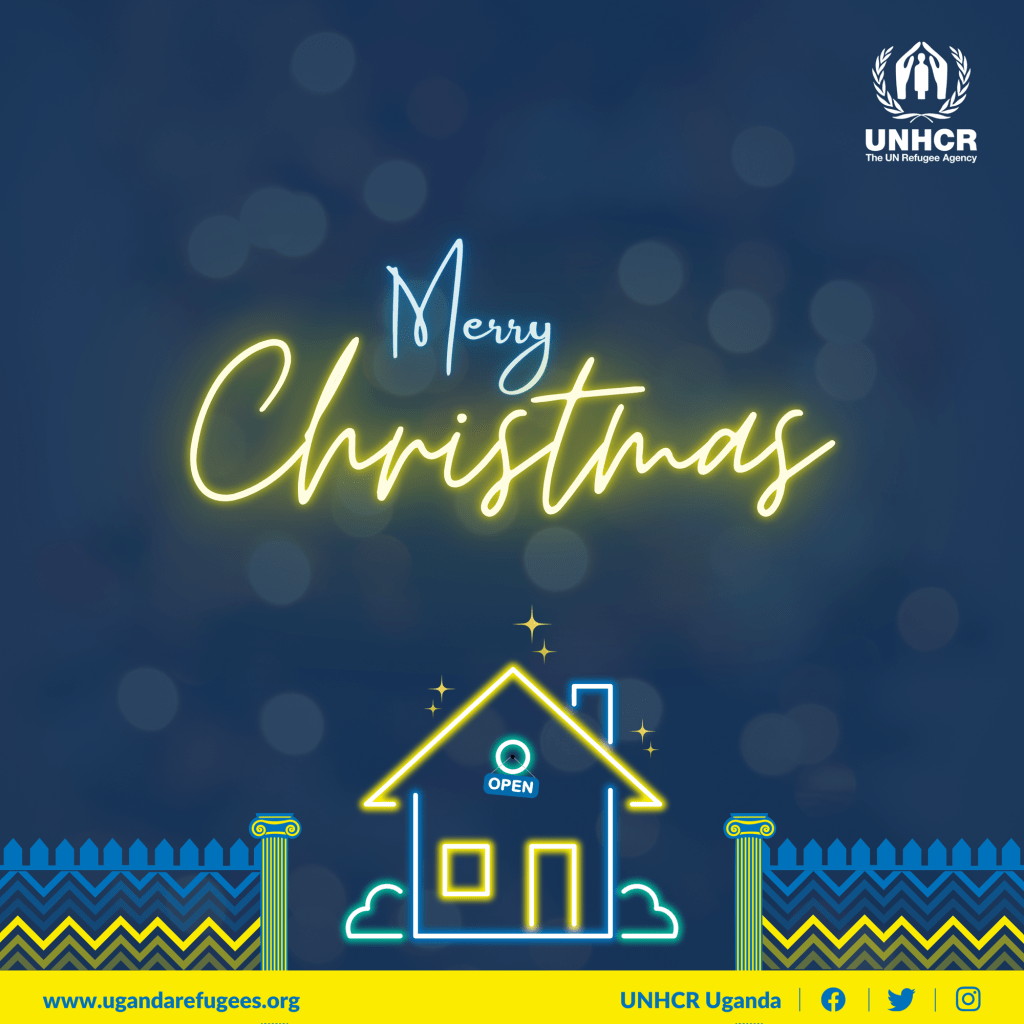
Since this design was created in 2021, it hasn’t been updated, as I am still working on a new design that keeps the message simple and direct. I don’t want to reinvent the wheel, having spent a year developing a card that remains relevant each year—unless there’s a shift in UNHCR’s mandate, the Uganda refugee model, or the Christmas traditions in Uganda. The design will also remain valid unless Uganda becomes home to reindeer and elves, or unless we start experiencing winter seasons in December, complete with snow-covered landscapes, fireplaces, and snowy villages.
The End.
#KikoleHati #TukundaneYonna #YesuNamara #2564wd
 Tukundane Yonna
Leave a comment